
For readers encountering Amedspor for the first time, the outline appears simple.
A football club, founded in 1972, now preparing to compete at the highest level after a steady rise through the leagues.
But Amedspor is not followed in the way most clubs are followed. To understand it, one must first understand the place it comes from.
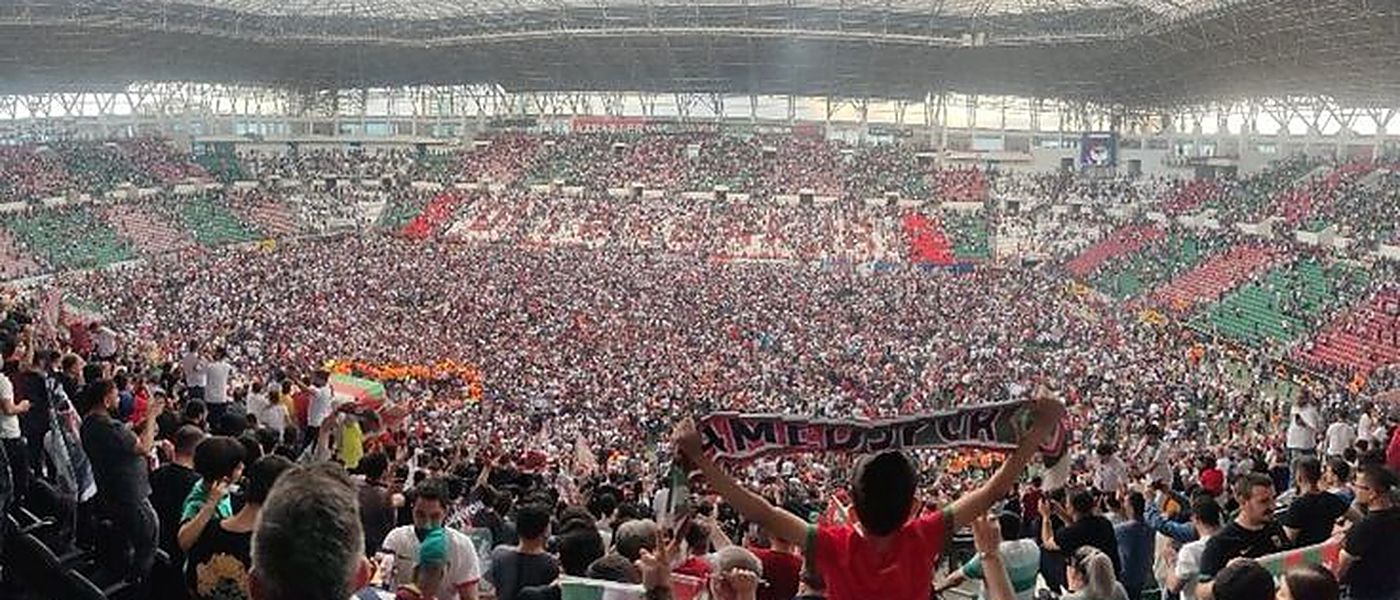
The City
Amed is an ancient Kurdish city, known for its long history, cultural continuity, and central place in Kurdish collective memory.
It is a city of stone walls and layered pasts, where history is not abstract but visible — in language, in daily life, and in the ways people describe where they are from.
For many, Amed is not simply a location. It is a reference point.
Amedspor carries that name.
A Name That Matters
When the club adopted the name Amedspor in 2014, it marked a shift that was both simple and significant.
The choice reflected a name already in use among the people of the city. But within football institutions, it was treated as something to be contested.
Over the years, the club has faced fines, restrictions, and repeated scrutiny — often connected not only to events on the pitch, but to how it is perceived beyond it.
These experiences have shaped the club's position. Amedspor is not only a participant in competition. It is also a subject of attention.
Pressure, Limits, and Persistence
Supporters and observers frequently point to a pattern: disciplinary actions, away restrictions, and decisions that appear disproportionate compared to other clubs.
Whether framed as institutional caution or something more structural, the effect has been consistent. The club has operated under pressure.
And yet, it has continued to grow. Attendance has increased. Diaspora support has expanded. Visibility has not diminished — it has intensified.
Representation in a Limited Space
For many Kurdish supporters, Amedspor occupies a space that is otherwise difficult to find in organized sport.
It is not the only example. In Sweden, Dalkurd emerged as a club carrying identity beyond sport. In the Kurdistan Region, teams like Zaxo have drawn strong regional attachment.
But Amedspor's position is distinct. Its matches are followed across borders, and its trajectory is closely watched by communities that rarely see themselves reflected at this level of competition.
For this reason, the club is often described not simply as a team, but as a form of representation. Not official. Not declared. But understood.
A Cultural Echo
The importance of Amedspor is sometimes explained through sport. It can also be understood through culture.
For generations, Kurdish writers, artists, and intellectuals have sought ways to communicate beyond immediate boundaries — to reach audiences that might not otherwise listen.
Publications like Hawar, produced under difficult conditions, attempted to create that space through language and literature. Their challenge was always the same: to be seen, to be heard, to be understood.
Amedspor operates in a different medium, but the underlying dynamic is familiar. Football provides a stage that does not require translation in the same way literature does. Matches are watched. Scores are recorded. Presence becomes visible.
For a community that has often struggled to make itself legible to wider audiences, that visibility carries weight.
Football, and Beyond It
None of this removes the basic reality: Amedspor is a football club.
It will be judged on results, performances, and decisions made on the pitch. The coming season will test its ability to compete, to adapt, and to remain at the level it has reached.
But for many of those who follow it, that is not the entire story.
Amedspor represents a convergence: a city with deep history, a dispersed audience across continents, and a form of presence that is rarely neutral.
A Club Now Seen More Widely
With promotion, Amedspor enters a space where visibility increases.
New audiences will encounter it without context. Others will follow it more closely than before.
Understanding the club requires holding two ideas at once: it is a football team, competing like any other. And it carries meaning that extends beyond the game.
Both are true. Neither cancels the other.