The name "Amed" is one of the historic names of central Diyarbakir, derived from the Syriac word Amed / Amîd / Amîdâ, whose existence dates back to around 1300 BC. The word later continued to be used in Kurdish as Amed or Amêd. By adopting this name in 2014-2015, the club directly emphasised the city's historical and cultural identity.
📜 AMEDSPOR TIMELINE · 1972 – TODAY
Amedspor History: From 1972 to the Süper Lig
A half-century journey from Melikahmet Turanspor to the Süper Lig. Name changes, colours, the double-headed eagle, titles and the identity a city built through football — a full timeline based on verified sources.
Founded
1972
First Name
Melikahmet Turanspor
City
Diyarbakir (Amed)
Colours
Green-Red
Stadium
Diyarbakir Stadium
~33,000
~33,000
Logo
Double-Headed Eagle
Titles
2nd tier (2024)
3rd tier (2007)
3rd tier (2007)
Süper Lig
2026 (First time)
Where Does the Name "Amed" Come From?
The club's name comes from the ancient history of the city.
Amedspor Year by Year
From foundation to the Süper Lig — every era the club went through, with verified dates.
1972 · Foundation
The club was founded as Melikahmet Turanspor, sponsored by Turan Gazozlari, in red-and-white colours. It began competing in the amateur leagues.
1985 · First Name Change
When the sponsorship ended, the club changed its name to Melikahmetspor.
1990 · Municipality Era
Diyarbakir Municipality bought the club. The new name became Diyarbakir Belediyespor and the colours green-white. Beyond football, branches such as boxing, volleyball and basketball were added.
1993 · Metropolitan
When Diyarbakir gained metropolitan status, the name became Diyarbakir Buyuksehir Belediyespor, noted for its focus on youth development.
1996 · Colour Change
The colours were changed from green-white to yellow-red.
1999 · DISKIspor
The club took the name Diyarbakir Buyuksehir Belediyesi DISKIspor.
2006-07 · First Title
The club won the third-tier title and was promoted to the second tier — its first-ever championship.
2010-2013 · Return
The DISKI name was dropped and the club reverted to Diyarbakir Buyuksehir Belediyespor.
19 May 2013 · Green-Red
After promotion to the second tier, a congress changed the colours to green-red — the colours of the old Diyarbakirspor.
28 Oct 2014 / 7 Jul 2015 · Amedspor Is Born
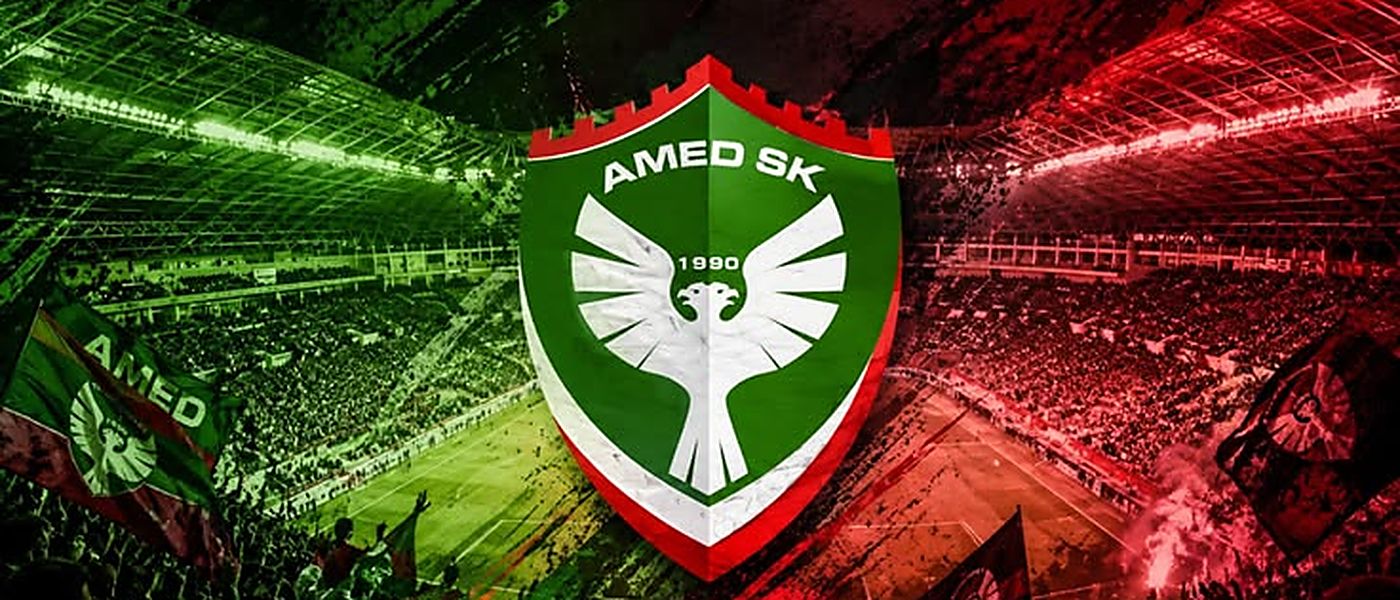
A congress changed the club's name to Amed Sportif Faaliyetler Kulubu. The logo was renewed with the double-headed eagle from the Diyarbakir Inner Citadel. The TFF initially rejected the name but it was registered as "Amed Sportif Faaliyetler Kulubu".
2016-17 · Play-off Semi-final
The club reached the second-tier play-off semi-finals — one of its best results at the time.
2023-24 · Historic Title
Amedspor won the second-tier title and was promoted to the 1. Lig for the first time. Tens of thousands of fans joined the celebration at Diyarbakir Stadium, with many Kurdish musicians performing.
2 May 2026 · Süper Lig
Amedspor was promoted to the Süper Lig for the first time in its history — the first club with an "Amed" identity to reach the top tier of Turkish football.
The Double-Headed Eagle: The Story Behind the Logo
Not just an emblem, but a city's historical memory.
🦅 What the Symbol Means
Amedspor's double-headed eagle is inspired by the figure at the Diyarbakir Inner Citadel. One head faces east, the other west — symbolising the city's strategic position between east and west. Throughout history the symbol has represented power, freedom, sovereignty and protection.
The double-headed eagle is a shared heritage of Mesopotamian and Anatolian civilisations, also seen in the Assyrian, Urartian, Seljuk and Byzantine cultures. Interestingly, Erzurumspor and Çorum FK — also promoted to the Süper Lig in 2026 — feature a double-headed eagle too, each rooted in their own regional history.
Beyond Football: Identity and Culture
For many of its supporters, Amedspor means more than a sports club.
Alongside its sporting identity, Amedspor is a club closely associated with the cultural identity of Diyarbakir and the wider region. Its supporter culture is intertwined with the city's historical heritage and local music. The participation of tens of thousands of fans and the performances of Kurdish musicians at the 2024 title celebration reflected the club's social resonance.
This cultural visibility has at times also met with administrative sanctions. According to a 2019 interview by the Germany-based Die Zeit, the club was at times treated differently by Turkish football authorities. As a documented example, between January 2016 and February 2019 supporters were barred from attending away matches for 64 games; in 2016 a player received a 12-match ban. These episodes brought the club's off-pitch dimension into public debate.
Today Amedspor is a club that has crossed borders — followed not only in Diyarbakir but also by a large diaspora community in countries such as Germany, Sweden, the Netherlands and the United Kingdom.
Honours Summary
2nd-Tier Title
2023-24
First promotion to 1. Lig
First promotion to 1. Lig
3rd-Tier Title
2006-07
Play-off Semi-final
2016-17
Promotion to Süper Lig
2026
Related Pages
Manager
Besnik Hasi Hub — New Süper Lig Manager
Guide
Amedspor: The Club from Amed — History & Identity
Süper Lig
Amedspor in the Süper Lig: 2026-2027 Guide
Kurdish Football
Kurdish Football Hub: Clubs, Diaspora, Identity
Explainer
Is Amedspor a Kurdish Club?
Rivals
Who Are Amedspor's Süper Lig Rivals?
Interactive
Build your Amedspor XI — Squad Builder
Frequently Asked Questions
When was Amedspor founded?
The club was founded in 1972 in Diyarbakir under the name Melikahmet Turanspor, sponsored by Turan Gazozlari.
What are the former names of Amedspor?
In order: Melikahmet Turanspor (1972), Melikahmetspor (1985), Diyarbakir Belediyespor (1990), Diyarbakir Buyuksehir Belediyespor (1993), DISKIspor (1999), and finally Amed Sportif Faaliyetler Kulubu (Amedspor) in 2014-2015.
What does the double-headed eagle logo mean?
It is inspired by the double-headed eagle figure at the Diyarbakir Inner Citadel. Its two heads face east and west, symbolising power, freedom and sovereignty. It is a shared heritage of Mesopotamian and Anatolian civilisations.
How many titles has Amedspor won?
A second-tier title (2023-24, first-ever promotion to the 1. Lig) and a third-tier title (2006-07). In 2026 it was promoted to the Süper Lig for the first time.
Why is Amedspor followed abroad and not only in Diyarbakir?
Because the club is associated with the cultural identity of Diyarbakir, it is closely followed by a large diaspora community in countries such as Germany, Sweden, the Netherlands and the United Kingdom.
Latest articles
- Kurdish-Language Film Premieres in Venice
- Koma Amed at Harbiye on 30 September
- Orban level at the top on six goals
- Goal of the week from Amedspor: a defence that has conceded five in five
- Amedspor v Beşiktaş: second in the table visits third
- 27 New Kurmanji Teaching Positions in Amed
- Two Amedspor shirts in London
- Amedspor 5-0 İstanbul Başakşehir